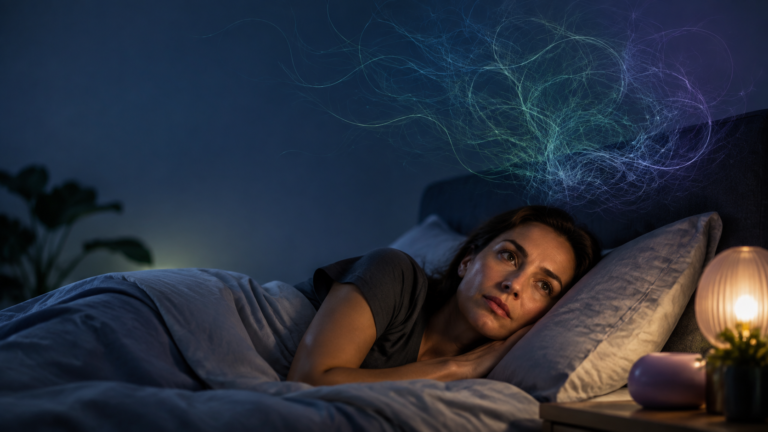
You went to bed at a reasonable time.
You slept for what looked like eight hours.
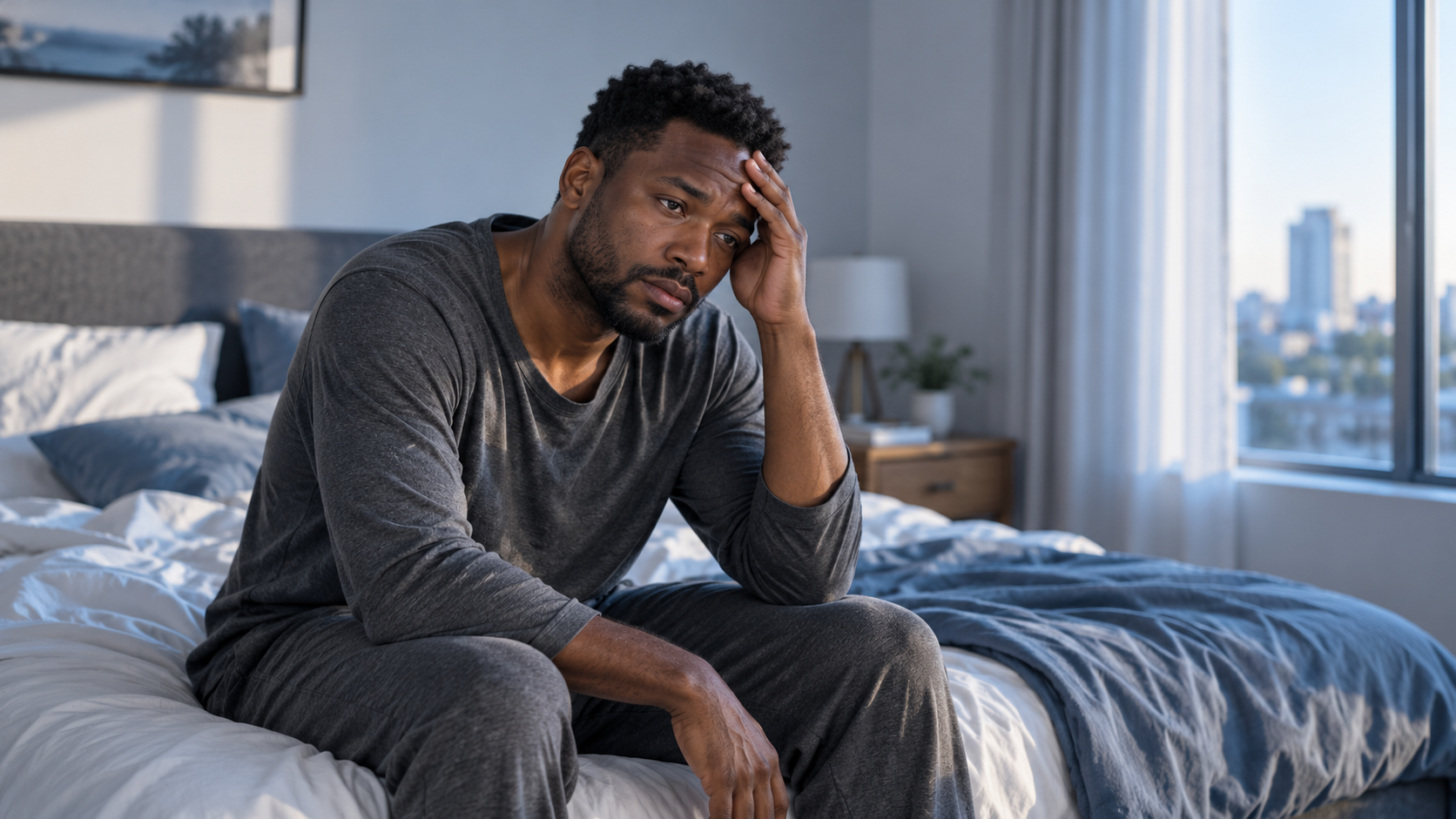
Your alarm goes off — and somehow you still feel exhausted.
It can be frustrating, particularly when you have followed the familiar advice to “get eight hours of sleep”.
But there is an important distinction.
Eight hours in bed does not necessarily mean eight hours asleep. And eight hours asleep does not guarantee that you will wake feeling refreshed.
Most healthy adults need around seven to nine hours of sleep a night, although individual needs vary. The NHS also highlights how you feel during the day as an important part of understanding whether you are getting enough sleep. [1]
So, if you seem to be sleeping long enough but still wake tired, what else might be happening?
Eight Hours in Bed Is Not Necessarily Eight Hours of Sleep
Imagine going to bed at 11 pm and getting out of bed at 7 am.
That is eight hours in bed.
But perhaps you took 30 minutes to fall asleep. You spent another 20 minutes awake during the night and woke 10 minutes before your alarm.
In that example, you slept for approximately seven hours.
It is easy to overlook this difference because we often describe sleep using the time between going to bed and getting up.
Time in bed and time asleep are different measurements.
Instead of asking only, “Did I spend eight hours in bed?”, try asking, “How long did I probably sleep, and was my sleep interrupted?”
You do not need to calculate this precisely every morning. A rough understanding of your usual pattern is more useful than turning every night into a maths exercise.
1. Your Sleep May Be Interrupted
A night can look long enough on paper while still containing periods of wakefulness.
Perhaps you remember waking several times. Perhaps you lie awake for a while after each awakening.
The useful question is whether these interruptions are happening regularly and whether they coincide with feeling unrefreshed or struggling during the day.
Noise, an uncomfortable bedroom temperature, stress and some medicines can affect sleep. The NHS also identifies alcohol, caffeine and certain health conditions as possible contributors to insomnia. [2]
If bedtime worry is part of your experience, our article on racing thoughts at night explores why your mind can feel busy when you want to rest.
When Night Waking Deserves More Attention
Loud snoring, breathing pauses, gasping or choking during sleep can be symptoms of sleep apnoea. Daytime symptoms can include substantial tiredness and difficulty concentrating. The NHS advises speaking to a GP if you have symptoms such as these. [3]
This does not mean everyone who wakes tired has sleep apnoea.
It means that persistent tiredness, especially alongside changes in breathing during sleep, deserves proper assessment.
If your main difficulty is waking after you have already fallen asleep, you can also read our article on why you might wake up at 3 am.
2. Your Sleep Schedule May Be Irregular
Sleep duration gets a lot of attention.
Your usual bedtime and waking time are worth considering too.
Imagine two people who both report sleeping for around eight hours.
One usually sleeps from 11 pm to 7 am.
The other sleeps from 10 pm to 6 am on some days, then from 2 am to 10 am on others.
Their sleep duration may be similar, but their routines are different.
The NHS recommends going to bed and waking up at around the same time each day as part of a regular sleep routine. [1]
You do not need to achieve perfect consistency. However, if your sleeping hours change considerably across the week, look at those changes alongside the number of hours you sleep.
A useful question is, “Does my routine give me a reasonably consistent opportunity to sleep?”
For people working shifts, that opportunity may be harder to create. Your routine needs to account for your actual working hours rather than assuming that everyone can follow the same bedtime.
3. Caffeine May Be Affecting Your Sleep
You might think, “Coffee does not affect me. I can drink it and still fall asleep.”
But falling asleep is only one part of the picture.
A systematic review and meta-analysis found that caffeine can reduce total sleep time and sleep efficiency, as well as increase the time taken to fall asleep. Its effects depend partly on the amount consumed and how close consumption is to bedtime. [5]
Sleep efficiency describes how much of your time in bed is spent asleep.
So being able to fall asleep after a coffee does not necessarily tell you whether caffeine affected the rest of your night.
Caffeine can also come from more than one source.
Coffee, tea, energy drinks and cola may all contribute to your daily intake. [1]
If you regularly wake tired, consider noting when you have your last caffeinated drink and whether your sleep feels different when you have it earlier.
This is a way of exploring a possible contributor, rather than assuming that caffeine explains every tired morning.
4. Alcohol Can Make You Sleepy Without Improving Your Sleep
Alcohol can make you feel sleepy.
That can create the impression that it helps you sleep better.
However, feeling sleepy after drinking and having an undisturbed night are different things.
The NHS explains that alcohol may make you sleepy initially but lead to poorer sleep later in the night. [1]
A systematic review and meta-analysis also found that alcohol can affect sleep structure, including reducing rapid eye movement, or REM, sleep. The effects varied according to dose and timing. [6]
If you fall asleep quickly after drinking but wake during the night or feel unrefreshed the next morning, alcohol is one possible factor to consider.
A single night cannot establish the cause. Looking at your experience across several nights may help you notice whether there is a pattern.
5. You May Be Experiencing Sleep Inertia
Sometimes the tiredness is strongest immediately after waking and gradually fades.
You get out of bed, but your mind still feels foggy.
This temporary period of grogginess and reduced alertness is known as sleep inertia. Research describes it as a transition after waking during which alertness and performance may take time to recover. [7]
The distinction is whether you gradually become more alert or continue feeling significantly tired throughout the day.
“I need a little time to wake up” is a different experience from “I struggle to stay awake all morning”.
If you repeatedly feel exhausted well beyond the period immediately after waking, do not assume ordinary morning grogginess explains everything.
6. Persistent Tiredness Is Not Always About Sleep
When you wake exhausted, it is natural to focus on sleep.
You might try a new pillow, a different bedtime routine, a sleep tracker or a supplement.
But sleep may not be the whole explanation.
The NHS lists several possible contributors to tiredness, including stress, depression, hormonal changes, illnesses and some medicines. Medical conditions such as iron deficiency anaemia, diabetes and thyroid problems may also need consideration. [4]
That does not mean you should diagnose yourself from a list of symptoms.
It means unexplained tiredness should not automatically be treated as a sign that you need a sleep product.
Sleeping for eight hours and still feeling tired does not, by itself, establish that you need a supplement.
A healthcare professional can help assess what might be contributing and whether further investigation is appropriate.
What If Your Smartwatch Says You Slept Well?
Your watch gives you a reassuring sleep score.
It reports plenty of deep sleep.
Yet you wake feeling terrible.
That mismatch can be confusing.
Consumer sleep trackers estimate sleep using signals such as movement and heart rate. They do not all measure sleep in the same way, and their results depend on the device and its algorithms.
A review of wearable sleep technology highlighted limitations in validation and accuracy. A more recent review also found that sleep-stage classification depends on the sensors and methods used. [8, 9]
A sleep score is an estimate, rather than a complete explanation of how you slept or why you feel tired.
A More Useful Way to Look at Tracker Data
Instead of focusing only on a single score, consider questions such as these.
- When am I usually going to bed?
- When am I waking up?
- Does my routine change considerably across the week?
- Do I remember being awake during the night?
- How do I feel in the morning?
- Am I struggling with sleepiness or low energy during the day?
A tracker may provide useful information, but persistent symptoms still deserve attention even when the score looks reassuring.
The Navaroa Five-Part Sleep Check
If you are still tired after what seems like enough sleep, use these five questions to organise your observations.
This is a simple reflection tool, not a diagnostic test.
1. Duration
Am I allowing enough time to sleep, and how much of that time am I actually asleep?
Remember that going to bed eight hours before your alarm does not necessarily mean sleeping for eight hours.
2. Continuity
Am I spending long periods awake during the night?
Think about the pattern across several nights rather than judging your sleep from one awakening.
3. Regularity
Are my bedtime and waking time reasonably consistent?
Consider whether workdays, days off or other commitments create substantial changes in your routine.
4. Timing
When does my sleep happen, and how does that fit around my daily commitments?
Record the timing as well as the duration. This can be useful context if you later discuss your sleep with a healthcare professional.
5. Daytime Function
How do I feel once I have had time to wake up?
Notice whether you are generally able to concentrate and manage your day, or whether tiredness and sleepiness repeatedly interfere.
The aim is to describe your experience more clearly, rather than give yourself a nightly pass or fail.
When Should You Speak to a GP?
The NHS advises speaking to a GP if you have been tired for a few weeks without knowing why, if tiredness affects your daily life, or if it occurs alongside other symptoms. [4]
You should also seek assessment for possible sleep apnoea symptoms, including breathing pauses or gasping and choking during sleep. [3]
For ongoing insomnia, the NHS recommends seeking help if changing your sleeping habits has not helped, you have had trouble sleeping for months, or it is making daily life difficult to cope with. [2]
Do not drive if you feel sleepy. [2]
You do not need to wait until you have tried every sleep tip before asking for help.
Looking Beyond the Number of Hours
Getting enough sleep matters.
But the number of hours does not tell the whole story.
You may be spending less time asleep than you realise. Your sleep may be interrupted. Caffeine or alcohol may be contributing. Your routine may vary considerably, or your early morning grogginess may gradually fade as you wake up.
Persistent tiredness can also have causes beyond sleep.
A more useful question is, “What does my sleep usually look like, and how do I feel during the day?”
If the answer remains “I am still exhausted”, particularly when it affects everyday life, appropriate medical advice may be more useful than another sleep product.
Frequently Asked Questions
Why Am I Still Tired After Eight Hours of Sleep?
There are several possible explanations. You may be counting time in bed rather than time asleep, spending periods awake during the night, or experiencing effects from caffeine, alcohol or other factors. Persistent tiredness can also have causes unrelated to sleep alone.
Is Eight Hours of Sleep Enough?
Most healthy adults need around seven to nine hours a night, but individual needs vary. Eight hours is a useful reference point rather than a guarantee that everyone will feel refreshed. [1]
Why Do I Wake Up Tired When My Smartwatch Says I Slept Well?
Your smartwatch estimates sleep using sensors and algorithms. A reassuring score cannot fully explain your symptoms or rule out a sleep problem. Consider your experience and longer-term patterns alongside the device’s estimates. [8, 9]
Can Sleeping Too Much Make You Tired?
Feeling tired after a long sleep does not tell you whether the duration caused the tiredness. If you regularly sleep for unusually long periods and still feel exhausted, discuss the pattern with a healthcare professional rather than assuming you should restrict your sleep.
Should I Take a Supplement If I Still Feel Tired?
Tiredness alone does not establish a need for a supplement. The appropriate response depends on the cause. If your tiredness is unexplained, persistent or affecting everyday life, seek advice before relying on a product to address it.
What Should I Record Before Speaking to a GP?
You could note your usual bedtime, waking time, estimated time asleep, periods of wakefulness and how tired or sleepy you feel during the day. Include any symptoms you or someone else has noticed, such as snoring or changes in breathing during sleep.
You do not need perfect records before making an appointment.
Sources and Further Reading
1. NHS. Sleep problems. Every Mind Matters.
Read the NHS guidance
2. NHS. Insomnia.
Read the NHS guidance
3. NHS. Sleep apnoea.
Read the NHS guidance
4. NHS. Tiredness and fatigue.
Read the NHS guidance
5. Gardiner and colleagues. (2023). The effect of caffeine on subsequent sleep. A systematic review and meta-analysis. Sleep Medicine Reviews.
View the research on PubMed
6. Gardiner and colleagues. (2025). The effect of alcohol on subsequent sleep in healthy adults. A systematic review and meta-analysis. Sleep Medicine Reviews.
View the research on PubMed
7. Hilditch, C. J., and McHill, A. W. (2019). Sleep inertia. Current insights. Nature and Science of Sleep, 11, 155–165.
Read the research
8. de Zambotti and colleagues. (2019). Wearable sleep technology in clinical and research settings. Medicine and Science in Sports and Exercise.
Read the research
9. Birrer, V., Elgendi, M., Lambercy, O., and Menon, C. (2024). Evaluating reliability in wearable devices for sleep staging. npj Digital Medicine, 7, Article 74.
Read the research
Medical Disclaimer
This article provides general educational information and does not replace individual medical advice, diagnosis or treatment. If you have persistent tiredness, sleep difficulties or other concerning symptoms, speak to an appropriately qualified healthcare professional.